Friday, October 15, 2010

The algae that want to conquer the world


Watch out microorganisms, a dominant algae takes over! Israel 21c

It almost sounds like the plot of a sci-fi thriller: A beautiful but deadly family of blue-green algae strong-arms other freshwater microorganisms into becoming their slaves, enabling them to take control of the water and threaten health the world over.

These dastardly cyanobacteria algae - the bullies of the freshwater playground - are no fictional characters. In a paper published online on August 12 in the journal Current Biology, a researcher at the Hebrew University (HU) of Jerusalem describes how they out-muscle their competition and proliferate dangerously, causing international concern due to their detrimental impact on water quality.

By shedding light on how the algae operate, 32-year-old Ph.D. student Yehonatan Bar-Yosef's research can help water experts find out how to outmaneuver the algae and assure safe drinking water for millions of humans and animals.

Back in 1994, when Bar-Yosef was still in high school, an enormous bloom of these toxic bacteria was found in Lake Kinneret, also known as the Sea of Galilee. As much of Israel's water supply is pumped from the Kinneret, this discovery was alarming. At the Alexander Silberman Institute of Life Sciences at HU, Prof. Aaron Kaplan began delving into the mystery.

Ten years later, Bar-Yosef came to Kaplan's lab looking for a topic for his graduate degree research. Interested in marine and microbiology, he took great interest in Kaplan's work with the blue-green alga known as Aphanizomenon.

He explains to ISRAEL21c that researchers already understood that algae blooms had something to do with the activity of enzymes used by microorganisms to scavenge inorganic phosphate compounds from their environment. His contribution was to pinpoint the source of the enzyme.

How To Become the Most Popular Person on a Boat


Brewing beer in a coffee maker, using only materials commonly found on a modestly sized oceanographic research vessel.

A graduate student studying population genetics in hydrothermal vent communities, was onboard a research vessel longer than he normally likes to go without beer. So he decided to brew his own, and now offers detailed instructions on how you can do likewise.

Find out how to brew your own at Southern Fried Science.

Thursday, October 14, 2010

Researchers find almost perfectly preserved 300-year-old pocket watch


Pretty cool find! Great treasure? India Talkies

London, Oct 12 : A corroded, barnacle-covered pocket watch recovered from a seventeenth-century wreck has revealed exquisite workmanship and almost perfectly preserved internal mechanisms of the rusty relic.

Researchers from the National Museums Scotland in Edinburgh used state of the art x-ray scans to reveal the delicate cogwheels and Egyptian-style pillars to the maker’s inscription.

They used the images to construct a three-dimensional virtual reconstruction of the watch’s lost workings. The watch and three-dimensional reconstruction are now on display in the Treasured exhibition of the National Museum of Scotland until 2011.

It was found on a wreck believed to be the Swan – a small warship that sank off the west coast of Scotland during the English Civil War. A naval diver discovered the wreck in the 1970s, and it was excavated in the 1990s.

Andrew Ramsey and his colleagues at the company X-Tek Systems in Tring, Hertfordshire, UK, had developed an improved CT technique using small yet high-voltage X-ray sources, which enabled them to obtain very high-resolution images, even when penetrating dense metal.

Troalen and Cox took the Swan watch to X-Tek (now owned by Nikon), and the resulting images taken by Ramsey and his colleagues have a resolution of 63 micrometres2 and show that much of the mechanism inside the watch is perfectly preserved.

“The results surpassed all of our expectations. We never thought that so much of the mechanism would have survived,” Nature quoted Troalen as saying.

Wednesday, October 13, 2010

Japanese fishermen ignore protests as dolphin hunting season opens


Check this out, in Taiji Dolphin's are still being slaughtered! News

Fishermen at the Japanese town made famous by the controversial Oscar-winning documentary The Cove shrugged off protests by animal rights activists yesterday to carry out their annual dolphin hunt.
Protesters said residents of the seaside village of Taiji butchered a whole pod of dolphins, apart from two that will be sold to aquariums and six young animals that were released.

For years, Taiji has held an annual dolphin hunt which begins in t
he autumn and continues until March. It has traditionally sold the best-looking animals to aquariums and killed the rest.

But the Oscar-winning documentary - which showed how herded dolphins were driven into a cove and stabbed, turning the waters red with blood - has intensified international opposition to the slaughter.

The film has met with fierce opposition in Japan from groups who say it is "anti-Japanese" and an affront to traditional culture. The work's Japanese opening in July was greeted with shouting protests from flag-waving demonstrators and a scuffle.

Unlike previous years, Taiji hunters have been setting some dolphins free, probably because of the growing pressure, said Scott West, a member of the Sea Shepherd conservation group who is in Taiji as part of a campaign to protect the mammals.

The village also has not killed any bottlenose dolphins - the most photogenic of oceanic dolphins. Instead, the mammals targeted have been risso dolphins and pilot whales (which are also dolphins but don't have the distinctive pointed noses of bottlenoses), Mr West said.

Last month, Taiji fishermen captured about a dozen bottlenose dolphins, which are still swimming in a netted area in a harbour separate from the cove.

A European conservationist group, Black Fish, said it cut nets in the harbour last month but the dolphins did not escape.

The young dolphins released yesterday appeared confused, perhaps looking for their parents, and it was unclear how well they will survive, Mr West said.

Japanese broadcaster TBS showed one activist - identified by Sea Shepherd as Steve Thompson of the Taiji Dolphin Action Group - raising his voice to fishermen about to leave for the hunt at about 5am.

"Today. No fishing. There is baby dolphin, pregnant dolphin.

Saturday, October 9, 2010

Decade-Long Census Of Marine Life Completed; 'We Prevailed Over Early Doubts'

After over ten years scientists now know there are over one million different creatures living in our oceans, pretty cool! UT

LONDON, England -- There are more than one million different types of creatures living in theworld's oceans today, according to a newly-released, decade-long effort to record marine life species around the world.

The Census of Marine Life, which was an international effort began that in the year 2000 and was officially completed on Monday, featured more than 2,700 experts, from over 80 different countries and territories, representing 670 different institutions.


"We prevailed over early doubts that a Census was possible, as well as daunting extremes of nature," Dr. Ian Poiner, chair of the Census Steering Committee, said in a statement. "This cooperative international 21st century voyage has systematically defined for the first time both the known and the vast unknown, unexplored ocean."

The researchers completed more than 540 expeditions and spent roughly 9,000 days at sea in order to formulate the world's first, comprehensive catalog of aquatic lifeforms. According to the Associated Press (AP), they successfully counted and validated a total of 201,206 different species, though the scientists who participated in the $650-plus million dollar project believe there are far more marine creatures out there yet to be officially recognized.

"All surface life depends on life inside and beneath the oceans. Sea life provides half of our oxygen and a lot of our food and regulates climate. We are all citizens of the sea. And while much remains unknown, including at least 750,000 undiscovered species and their roles, we are better acquainted now with our fellow travelers and their vast habitat on this globe," said Poiner.

According to the Census findings, more than 16,000 new species have been discovered since the start of the cataloging effort in 2000, including 1,200 new species collected and described by participating scientists over the past 10 years and over 5,000 others that were collected during the Census but have yet to be described. In a press release, Census officials estimate that between 100 and 150 new fish species were encountered every year, and an estimated 5,000 others have yet to be discovered. They also estimate that there could be over one billion types of marinemicrobes in the world.

"The Census enlarged the known world," said Myriam Sibuet, Vice-Chair of the Census Scientific Steering Committee. "Life astonished us everywhere we looked. In the deep sea we found luxuriant communities despite extreme conditions. The discoveries of new species and habitats both advanced science and inspired artists with their extraordinary beauty. Some newly discovered marine species have even entered popular culture, like the yeti crab painted on skateboards."

Starting on Monday, over 300 key members of the Census are scheduled to participate in a three-day meeting at the Royal Institution of Great Britain, the Royal Society, and Natural History Museum in London to discuss and share their discoveries. A second Census will also be discussed during this week's meeting, as well as during next fall's World Conference on Marine Biodiversity in Scotland.

"The Census united scientists from more than 80 nations with different talents, equipment, and interests," Paul Snelgrove, who led the assembly and report of the Census results, said in a statement on Monday. "It matched the immensity and complexity of ocean life with a human enterprise able to grasp it. The understanding and well-being of marine life may well depend on continued unity of international science."


Friday, October 8, 2010

Interview with Jason Coffrin


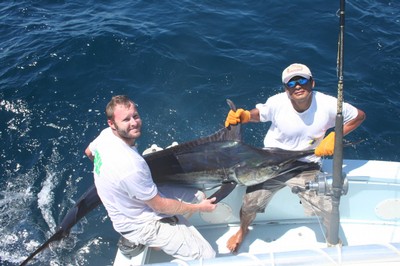
Neptune’s Defenders had an opportunity to sit down with Jason Coffrin, owner and operator of Mr. Trigger Sport fishing in Flaming/Carrillo Costa Rica, and ask him a few questions. Jason was born and raised in Sarasota, Florida and started fishing when he was 2 years old and hasn’t stopped since. Jason says, “Fishing for me has been a mission not a hobby.”


Mr. Trigger Sport fishing in Flaming/Carrillo Costa Rica specializes in family fishing, inshore grouper fishing, and Roosterfish. Jason actually holds the unofficial world

record Roosterfish released unharmed at 157lbs. Jason also specializes in Marlin: Blues, Blacks, Stripes, Sailfish, Yellow fin tuna, Wahoo, and Mahi Mahi.


Neptune’s Defenders: Jason when did you first start fishing; was it saltwater, freshwater, or both?


Jason Coffrin: I have been fishing for 28 years since I was 2 years old. My first fish was a catfish in a cow pond and now I’m chasing the dream of a 2000lb Marlin in Costa Rica.


ND: What made you decide that you wanted to be a fishing guide for a living and

what made you choose Costa Rica?


JC: I had a serious back surgery in 2007 where I was in bed for 7 months, followed

by a crazy near death car accident 2 weeks later. That’s when I put the dream

together, to head to Costa Rica to pursue bill fishing. I was there in 2005 working

with a friend on his boat to help out and also a mate on a dive boat. That is why

I chose Costa Rica. Also the different species of Marlin: Blues, Blacks, Stripes, and

Sail fish all year round. So in 2007 I bought a really beat up 26 Morgan and

rebuilt it with the help of friends at Ingman Marine in Sarasota FL. I Couldn’t

have done it with out them!


ND: Do you practice sustainable fishing with catch and release of Billfish?


JC: I am a stickler when it comes to releasing Billfish! I do tag bill fish for the

Bill Fish Foundation, and even have been know many times for jumping in

and swimming with these giants until they are ready to go. Check flamingo-fishing.com for photos of that!


ND: What fish would you say is the most over-fished in Costa Rica?


JC: Tuna by far is the most over fished. We sometimes have large tuna schools

headed in our direction and are cut off by certain boats; the schools are totally

consumed!


ND: What fish would you say is the most endangered or negatively impacted

from fishing in CR.


JC: My opinion, Marlin and Tuna.


ND: What good eating fish is in the most abundance in CR?


JC: Mahi Mahi and Grouper are all over, you just have to go with the right Captain…Mr. Trigger (smiles).


ND: In your opinion, does anyone give fishermen a bad name in CR? If so,

who?


JC: Some fishermen give others a bad name straight up through jealousy…

I’m a huge target being young, new, and a fish catcher, but there a ton more

willing to help all the time! I’ve only experienced the jealousy in CR...everywhere else has been straight up help! It’s an awesome ride!


ND: What is the one thing people need to know about fishing in CR that they

probably don’t know about?


JC: Mr. Trigger Sport fishing is the way to go if you want to have a great time with

your family, wife, kids, friends, or going for that record marlin of any kind. We

are the boat for you. Supplying fun and memories for everyone on the planet!


ND: If money were no concern, how would you advise a friend on how to get the most

out of a 3-5 day trip to CR?


JC: Contact me on jctriggerman@yahoo.com; I will put together a trip of a lifetime!

I’d be happy to help anyone. Stay in the nicest hotel and if you are targeting that

trophy catch, come when the Captain wants you to. The Captain knows when

you are going to get that memorable catch!


ND: If money were extremely tight, how would you advise a friend on how to get the

most out of a 3-5 day trip to CR?


JC: I have several small places to stay in my area and I would gladly set you up

in one. We can talk about our fishing if you tell me a little about you. Anyone

can come to Costa Rica and have a dream vacation. We will help you out at

flamingo-fishing.com


ND: If you had to estimate, how many people, tourists, or locals take Billfish

to put on their wall or eat?


JC: We have our Billfish mounted by King Sail fish mounts and all fish are released,

I do a photo and measurements and that is the only thing sent in. As far as eating,

no one kills one on my boat for that purpose! Locals, I’m not sure, I stay out of

that…tourists…most boats have the same beliefs as I do on the matter. Billfish keep our sport alive.


ND: What is your best fishing story?


JC: I was fishing the PTTS in Boca Grand for tarpon and had a free jumping tarpon

hit me in the face while I was in the chair fishing. It estimated over 170lbs. It hit me

so hard, I broke the steel chair off the boat. I also had the billfishreport.com guys

down, Hook Harmeling and Brooks Anderson. I hooked a Blue Marlin in the tower

and it spooled a 30lb. class reel in 10 seconds flat, 2 times. I fought it for 4 hours in a storm with 5-foot waves. We got it up and chased it at 25 mph until it spooled us again, jumped 13 times then dove again to chase bait…that is a BAD fish! Those are truly monsters of the sea. I get tips and techniques from the great Bart Miller, CEO and founder of Black Bart lures. Everyone that has caught a Billfish on plastic has heard of him. Now he is teaching me. The man is a marvel!


ND: Any close calls or hairy situations while living outside the US?


JC: I have had no problems living outside the US, the people are great and the food is

awesome!


ND: Outside of fishing, what is your favorite outdoor activity to do in CR?


JC: Working on my boat! That’s all I do, I’m eaten up with it!


Contact Jason Coffrin:


Mr. Trigger:

US. Cell: 941-232-3929

US. Office: 941-366-6871

Email: jctriggerman@yahoo.com

Website: flamingo-fishing.com

Booking site: fishmrtrigger.com/paypalaccount

Thursday, October 7, 2010

Mandatory Reading: Experts question BP's take on Gulf Oil Spill

READ THIS! Share this! People need to know the truth. Lot's of pointing fingers, not so much taking accountability or making good faith efforts to really dig into the totality of this mess.

WASHINGTON (AP) -- Engineering experts probing the Gulf of Mexico oil spill exposed holes in BP's internal investigation as the company was questioned for the first time in public about its findings. BP's lead investigator acknowledged that the company's probe had limitations.

Mark Bly, head of safety and operations for BP PLC, told a National Academy of Engineering committee that a lack of physical evidence and interviews with employees from other companies limited BP's study. The internal team only looked at the immediate cause of the April disaster, which killed 11 workers and unleashed 206 million gallons of oil into the Gulf.

"It is clear that you could go further into the analysis," said Bly, who said the investigation was geared to discovering things that BP could address in the short term. "This does not represent a complete penetration into potentially deeper issues." For example, the National Academy of Engineering panel noted that the study avoided organizational flaws that could have contributed to the blast. BP has focused much of its work on decisions made on the rig, not with the managers on shore.

Najmedin Meshkati, a professor at the Viterbi School of Engineering at the University of Southern California, said he wondered why BP named its report an accident investigation when it left critical elements out. He asked BP to turn over information on shift duration and worker fatigue. "How could you call this great work accident investigation ... (without) addressing human performance issues and organizational issues and decision-making issues?" Meshkati asked. He referred specifically to the confusion that occurred leading up to the explosion, when many workers aboard the rig were busy with work associated with finishing up a well. This distraction could have led to missed signs that something was wrong.

"It wasn't intended to be anything that it isn't," Bly responded. "It was a good contribution and a good foundation for further work for BP itself and others." Other experts questioned one of BP's central conclusions that the oil and gas traveled up the center pipe, rather than the space outside the pipe. One wanted to know whether a device designed to shut off an engine when it starts to rev - as it would in the presence of gas - failed. BP said it didn't know if the device worked or not.

BP's study found eight separate failures led to the oil rig accident. The report blamed BP and other companies, including Transocean, the rig's owner, and Halliburton Co., which was hired to do the cement work. But the conclusions were made without examining the drilling rig, which remains on the sea floor, or the blowout preventer, a key safety device that was brought to shore only recently. Instead, the company relied extensively on real-time data collected aboard the rig to reconstruct what happened. BP also did not have access to samples of the cement used to seal the well, and said Halliburton refused to supply a similar mix for testing. BP has said the cement failed.

Halliburton officials criticized the methodology that BP used to draw its conclusions and claim that the well's design played no role in the incident. Thomas Roth, a Halliburton vice president, took aim at testing by a company hired by BP that found Halliburton's cement, which was injected with nitrogen to form a foam, was unstable. "BP's well design and operational decisions compromised well integrity," said Roth. "BP proceeded with well operations without establishing well integrity. In the end, BP followed a decision tree that ignored multiple red flags."

When asked why Halliburton continued to work on the well despite some of these red flags, Roth said, "We didn't see it to be an unsafe operation as it was being executed." The National Academy of Engineering was asked by the Interior Department to look into the causes of the disaster and identify ways to prevent similar accidents. A report with the committee's preliminary findings will be published no later than Oct. 31.

Full Article